Interview
The Empty Bed
Artwork by Megan Howard
Stripes
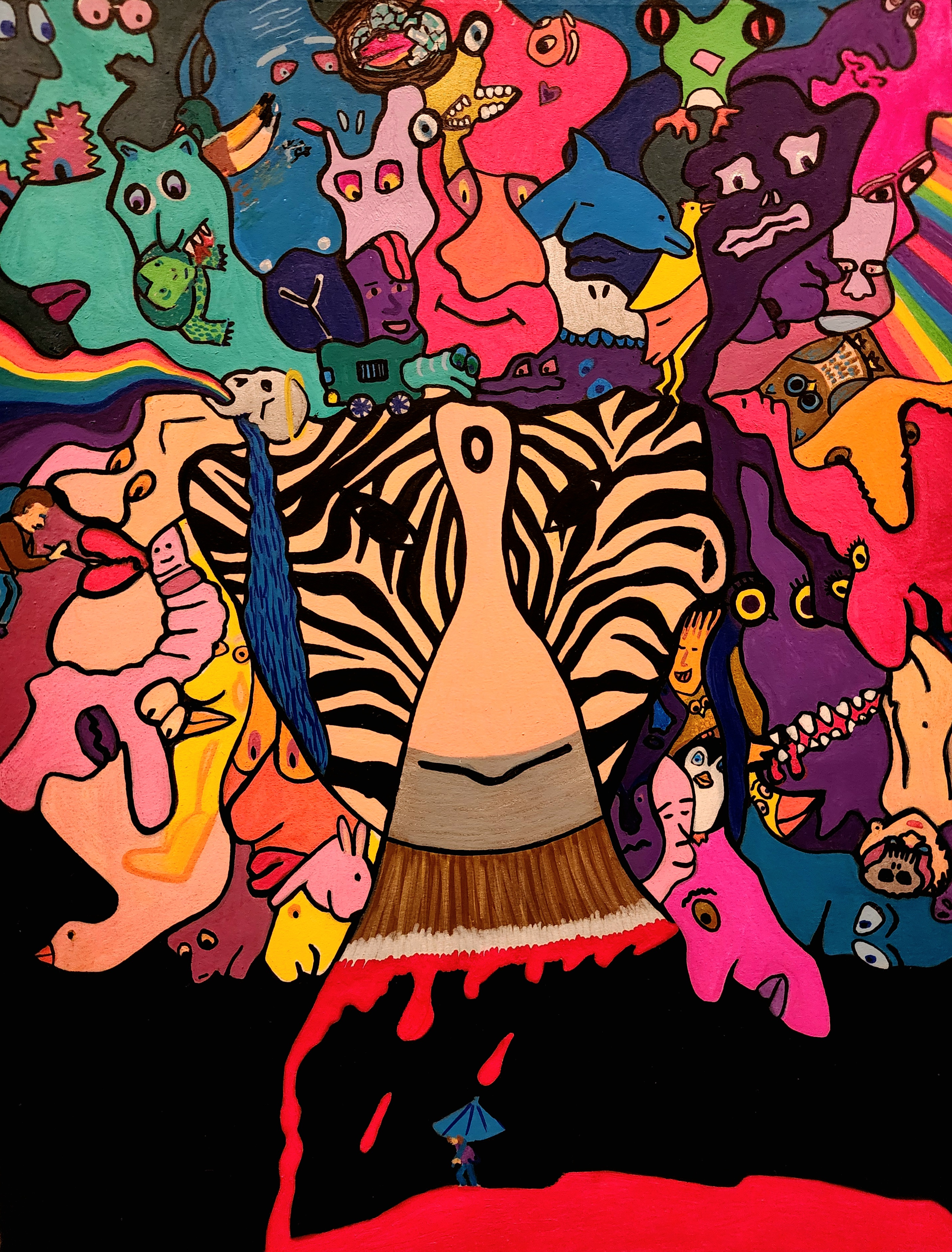
Life in Pain

The bed is empty on purpose.
That is one of the first things I want people to understand about Life in Pain. The bed became empty so other people could place themselves inside it.
That bed is not only my bed. It is the bed of anyone who has lived through isolation longer than the world wanted to remember. It is the bed of anyone whose body has made the room smaller. It is the bed of anyone who has watched life resume for others while their own life stayed paused.
During the COVID-19 pandemic, people spoke openly about loneliness. They missed jobs, restaurants, friends, ordinary movement, the freedom to leave home without calculation. For many, isolation was new. For me, it was familiar. By then, I had already been homebound and mostly bedbound for years.
I knew what it meant to live in a world that kept going without me.
My primary diagnosis is Behçet’s disease, a rare vasculitis and autoinflammatory autoimmune condition. Some of my symptoms trace back to childhood, but as a teenager they arrived more forcefully. Compared with many rare disease patients, my diagnosis came quickly: after about a year and nine specialists. But “quickly” is a complicated word in rare disease. My body had been speaking for much longer.
Even after diagnosis, I remained ambitious. I earned a master’s degree in art therapy counseling, hoping to bring art’s healing power to others. But as I graduated, new symptoms emerged. Dysautonomia changed the shape of my life. I became dependent on a wheelchair. I needed feeding tubes, an ostomy, and eventually spent much of my life in bed. Idiopathic hypersomnia brought another layer of exhaustion, leaving me not only in pain but fighting through deep fatigue whenever I was awake.
Still, art remained.
Before glass, before the hospital bed sculpture, and before my art pieces that I submit now, art had already been my way of surviving myself. In middle school, I began writing down emotions that felt too vulnerable to leave exposed. Then I scribbled over the words, turning them into drawings. Eventually, the drawings became safer than language. Art let me say what words could not.
When I became sicker, I leaned further into it.
I began working with glass at nineteen, first through flameworking, melting glass with a torch. But as pain increased and my body changed, I could no longer hold my arms up the same way. I shifted into fused glass, cutting and layering pieces that could be joined in a kiln. For Life in Pain, I also used casting, wire, glue, and assemblage, building a three-dimensional hospital bed from materials that required patience, adaptation, and problem-solving.
Glass compelled me because of the challenge. It did not give up its meaning easily. Neither did my body.
There are tiny pill bottles in the piece, labeled with my name and actual medications. There is a small book titled Art Heals. Nearby is another: Life in Pain. Together, they hold the contradiction I live every day. Pain is not romantic. It is not beautiful because it hurts. But art can give pain somewhere to go. It can make a room inside suffering where purpose still exists.
The bedrails look almost like prison bars. That, too, is intentional. For me, the bed is both prison and sanctuary. It is where I am confined, but also where I find the most comfort. It is where pain keeps me, and where heating pads, rest, caregivers, sketchbooks, and art supplies help me endure. The iridescence of the glass makes that contradiction visible: beauty and suffering, comfort and captivity, healing and limitation, all occupying the same space.
Caregivers make that space livable.
I want people to understand that someone can create intricate, beautiful, technically demanding art and still need help getting dressed, showering, picking up medication, and completing daily tasks. Dependence does not erase talent. Disability does not erase creativity. Needing care does not make a life less full, less serious, or less worthy of support.
Telehealth changed my life because leaving home costs energy I often do not have. Getting out of bed, dressing, sitting in a wheelchair, traveling to an appointment, waiting for specialists, and returning home can consume everything. Telehealth cannot replace every visit, but when it can substitute even some appointments, it gives something back. Saved energy can become life. It can become art. It can become one small portion of a day used for joy instead of survival logistics.
That is part of what Life in Pain advocates for: not only sympathy, but access. Not only awareness, but caregiver support. Not only admiration for what I create, but recognition of what makes creation possible.
Then there is Stripes. If Life in Pain shows the room of illness, Stripes shows the self inside it.
I created Stripes from bed with paint markers. It is a self-portrait bursting with color, symbols, hidden figures, and movement. The central face is covered in zebra stripes, the familiar emblem of rare disease. But these stripes are not passive. To me, they feel like warrior paint. They represent the battles written across a life, even when others cannot see them.
A paintbrush becomes my nose. Its bristles extend downward and drip red paint. Below, a smaller version of myself holds an umbrella, trying to shield herself from the falling red. The red represents blood loss, including moments when I nearly died. The umbrella represents protection, survival, the part of me still trying to withstand what my body has endured.
Around the face are characters: strange, bright, humorous, tender, unsettling, joyful. They radiate like hair, but also like a living map of personality. Hope is there. Humor is there. Fear is there. Resilience is there. Caregivers and support systems are there. Hidden images wait for viewers to find them, just as hidden illness often waits to be recognized.
I know the complexity of visibility. If someone sees me in a wheelchair, they may recognize disability. But if they see only a smiling photo of my face, they may not imagine the illness beneath it. That hiddenness can be both blessing and burden. It allows privacy, but it also forces people with rare disease to fight to be believed.
Stripes insists there is more than one face to survival.
It asks viewers to look longer. To notice what is hidden. To understand that everyone carries battles, and that no one survives alone. The colorful figures around the portrait are not just decoration; they are community. They are humor when pain is unbearable. They are caregivers, loved ones, advocates, and fellow patients. Before I found rare disease community, it was harder. Finding others who understood helped me feel less alone.
Both pieces, in different ways, are about the same truth: illness can confine a body without erasing the person inside it.
I create from bed. I create through pain. I create with fatigue, limitation, adaptation, and help. But I also create with playfulness, precision, humor, courage, and imagination. My work does not ask viewers to pity me. It asks them to recognize the reality behind what they may not see.
The empty bed is not empty.
It holds pain. It holds art. It holds isolation, caregivers, telehealth appointments, pill bottles, heating pads, sketchbooks, and unfinished dreams that still found a way to become glass.
And the striped face is not only illness.
It is a warrior. It is a chorus. It is me saying: I am still here, and there is more to see.
The bed is empty so you can enter it.
Not because pain is gone,
not because the body has disappeared,
but because isolation
has many names,
and one of them
might be yours.
I built the bed
from glass,
from heat,
from broken pieces,
from the kind of patience
only illness teaches.
The rails rise
like prison bars,
but shimmer
like sanctuary.
the place that holds me
is also the place
that helps me survive.
A book says
Art Heals.
Another says
Life in Pain.
Both are true.
I learned early that words could be too exposed,
so I buried them
under scribbles
until scribbles
became drawings,
until drawings
became language.
COVID taught the world
a little about isolation.
Then the world opened.
My room did not.
So I made the room visible.
I made the bed beautiful enough to look at
And honest enough to hurt.
And then came stripes,
zebra across my face,
warrior paint for the rare,
a brush for a nose,
red falling from bristles
like memory, like blood,
like all the times
the body came close to leaving.
Below it,
a smaller self holds an umbrella
against what keeps coming down.
Around my head,
a crowd gathers:
humor,
hope,
fear,
resilience,
caregivers,
friends,
the strange bright faces
of survival.
Look closely.
There are hidden things everywhere.
That is how illness lives,
visible only to those willing to search.
I can make art intricate enough to astonish you
But still need help
getting dressed.
I can smile in a photograph
and still be fighting inside the frame.
I can be mostly bedbound
and still be in motion.
A glass bed. A striped face. A body in pain. A life still making color.
This is not only a story of illness.
It is a story of access, of caregivers, of telehealth giving back a little energy, of art supplies
kept within reach, of a person who turns limitation into witness.
The bed is empty
so you can see yourself.
The face is crowded
so you can see
I was never only sick.
Pain may narrow the room,
but art keeps opening a door.